
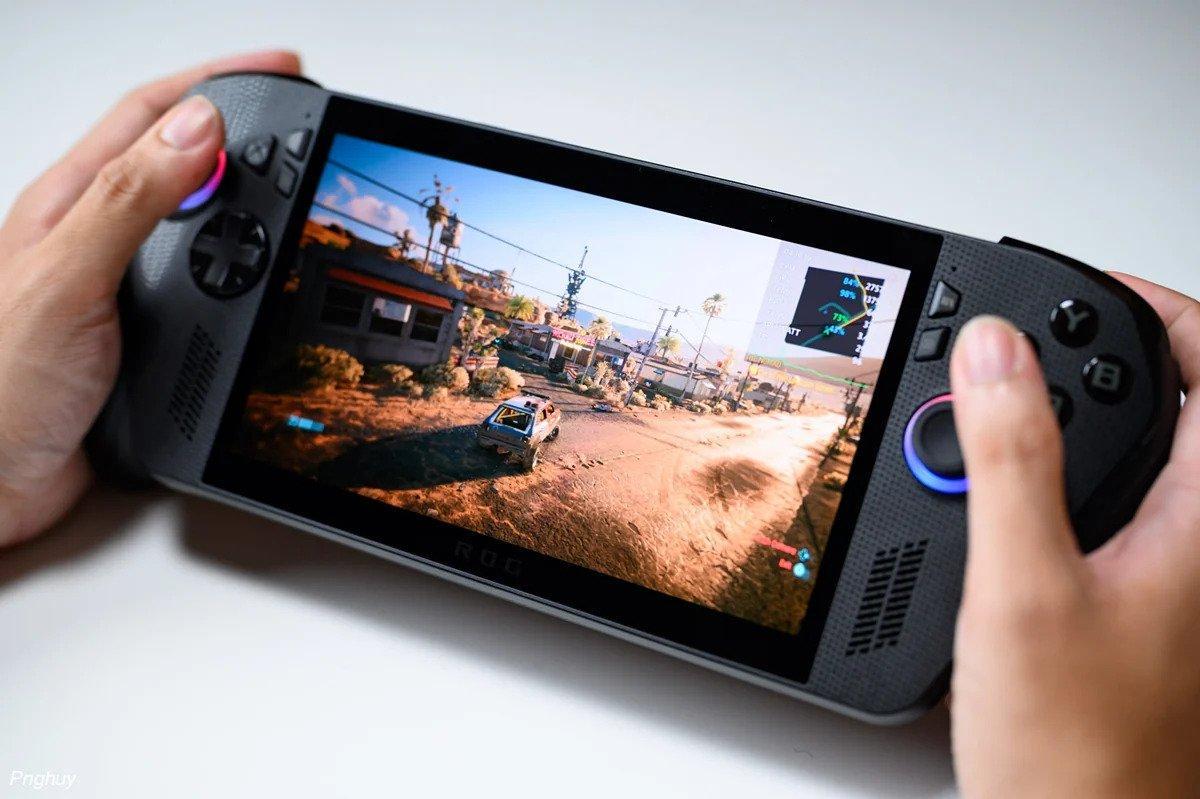
Microsoft Brings 120 FPS AI Upscaling to the ROG Xbox Ally X
For years, manufacturers have promised that artificial intelligence would make personal computers faster, smarter, and more useful. But for many gaming handheld owners, the neural processing unit inside their device has felt more like an expensive specification than a feature they actually use.
ROG Xbox Ally X Owners Get More From Their Neural Processing Unit
Microsoft is now giving that hardware a more practical purpose. Its Automatic Super Resolution technology, or ASR, is officially leaving preview and arriving on selected ROG Xbox Ally devices. The update introduces higher frame-rate support, removes the need to connect the handheld to a dock, and adds compatibility with Windows Auto HDR.
The bigger story is not simply better graphics. It is the growing competition to make artificial intelligence a standard part of gaming performance.
Microsoft Moves AI Upscaling Into Everyday Gaming
Microsoft is rolling out ASR to the ROG Xbox Ally X and the premium ROG Xbox Ally X20 models, alongside selected AMD Ryzen Copilot+ PCs.
The technology competes with established graphics solutions such as Nvidia DLSS, AMD FSR, and Intel XeSS. These systems aim to improve gaming performance by rendering images at a lower resolution and using advanced processing to reconstruct a sharper final picture.
The practical benefit is straightforward. A handheld device has limited battery capacity, cooling capability, and processing power. If software can produce a visually convincing image without requiring the graphics hardware to render every pixel at full resolution, the device can potentially deliver smoother gameplay with fewer hardware resources.
That matters much more on a portable computer than on a large desktop gaming system.
Performance Mode Raises the Ceiling to 120 FPS
The most significant addition is a new Performance Mode.
Microsoft says ASR can now operate at up to 120 frames per second, compared with the previous range of approximately 60 to 75 FPS.
Frames per second measure how many images a device displays every second. Higher frame rates generally make movement look smoother, particularly in fast-paced games.
Microsoft has also removed the previous requirement to dock the Ally before using ASR. The feature now works in handheld mode, including when the device runs on battery power.
It supports the Ally family's full 1080p resolution, although Microsoft product manager Stefan Bojanic cautions that performance at 1080p in handheld mode may not be as optimal as in other configurations.
The technology may be particularly useful for older games, where visual improvements can make a noticeable difference without demanding the latest hardware.
The Neural Processing Unit Finally Has a Purpose
A neural processing unit, commonly called an NPU, is a specialized processor designed to handle artificial intelligence workloads efficiently.
Modern computers increasingly include these chips, but their usefulness depends on whether software developers build features that actually use them.
That has been a weakness for some high-end handheld devices. Asus has previously promoted the NPU in its Ally hardware, including its ability to support highlight reels. However, that feature alone has not made the additional processing hardware feel essential to most players.
ASR changes the equation.
Instead of treating the NPU as a specification that looks impressive on a product page, Microsoft is connecting it to something gamers can directly experience: image quality and performance.
This is an important distinction in consumer technology. Hardware capabilities only become valuable when software turns them into practical benefits.
Auto HDR Adds Another Layer of Visual Improvement
The update also makes ASR compatible with Windows Auto HDR.
Auto HDR enhances the colors and lighting of games that were originally designed without HDR support. HDR, or High Dynamic Range, allows compatible displays to show a wider range of brightness and color.
Combining upscaling with Auto HDR gives users two separate ways to improve the visual experience.
One technology focuses on reconstructing images. The other improves how those images are displayed.
Microsoft says Performance Mode and Auto HDR compatibility will arrive through Windows updates, meaning availability may vary as the rollout reaches individual devices.
Microsoft Is Building a Software Advantage Around AMD Hardware
The ROG Xbox Ally X is built around AMD's Z2 Extreme processor. Microsoft's ASR gives this hardware another software feature that could help differentiate it from older handheld devices.
The timing is notable because AMD launched FSR 4.1 for devices using Z2 Extreme processors the previous month, including the ROG Xbox Ally X and X20.
That means owners of compatible handhelds now have access to competing technologies from both AMD and Microsoft.
Nvidia's DLSS remains an important competitor in the broader gaming market, although it is not natively supported on ROG Ally devices. Unofficial workarounds exist, but they are not equivalent to official platform support.
The competitive advantage may increasingly come from the combination of processor design, graphics software, operating system integration, and developer support.
A chip alone does not create a compelling gaming platform. The surrounding software ecosystem does.
The Upgrade Question Is More Complicated Than It Looks
The new features give owners of older Ally devices another reason to consider upgrading. However, the performance difference between generations deserves attention.
The original ROG Ally models use AMD Z1-series processors, including the Z1 Extreme. According to benchmarks published by Windows Central in October of the previous year, the newer Ally X generation delivered approximately 10% to 15% better performance than the Z1 Extreme model.
That is a relatively modest improvement considering the broader hardware changes.
The original devices remain capable of playing most games, excluding the most demanding titles. As a result, ASR may be more important as a software advantage than as a reason to replace an otherwise functional handheld.
For buyers, the decision should depend on the games they play, their expectations for battery life, and whether the new features make a meaningful difference in everyday use.
The Real Competition Is About Making Limited Hardware Go Further
Portable gaming devices face a difficult business problem.
They need to offer attractive graphics and smooth performance while operating within strict limits on battery size, heat, weight, and cost. Increasing raw hardware power is only one possible solution, and often an expensive one.
AI-assisted graphics offers another path.
If software can improve the final image while reducing the amount of work required from the main graphics processor, manufacturers may be able to deliver better experiences without constantly increasing hardware specifications.
This creates value for several parts of the industry.
-
Microsoft strengthens Windows as a gaming platform by making operating-system features more useful.
-
AMD gains another opportunity to demonstrate the capabilities of its newer processors.
-
Asus can market the Ally X family around features that older devices may not fully support.
-
Game developers gain additional ways to improve visual quality across different hardware configurations.
-
Players may get smoother gameplay without immediately purchasing a more powerful device.
However, the benefits depend on real-world implementation. Upscaling quality, latency, power consumption, and compatibility can vary between games and configurations.
A headline figure of 120 FPS does not guarantee that every game will run at that speed.
Small Businesses Can Learn From Microsoft's Hardware Strategy
There is a useful lesson here for smaller technology companies.
Microsoft is not relying entirely on selling more powerful hardware. It is increasing the value of hardware that customers already own by improving the software around it.
Small and medium-sized businesses can apply the same principle.
A company does not always need to launch an entirely new product to become more competitive. It can improve an existing service through automation, AI-assisted workflows, better integrations, and more useful customer features.
For example, a software company could use AI to help customers complete tasks faster instead of simply adding an AI chatbot to its interface. An online retailer could use intelligent image processing to improve product presentation. A service business could automate repetitive administration while allowing employees to focus on customer relationships.
The important question is not whether a business uses AI. It is whether AI makes the product measurably more valuable.
Companies should start by identifying expensive or frustrating tasks, testing automation on a small scale, and measuring improvements in time, cost, and customer satisfaction.
Microsoft's approach offers a clear example of this principle. A specialized processor becomes meaningful when software turns its capabilities into something customers can see and feel.
AI Software May Become the Next Gaming Hardware Advantage
Microsoft's ASR rollout is a relatively small update compared with a new console or processor launch. Yet it points toward a larger shift in the gaming industry.
Performance will increasingly depend on how intelligently hardware and software work together.
For handheld gaming, that could mean better graphics, higher frame rates, and more efficient use of limited power. For Microsoft, it creates another opportunity to strengthen Windows. For AMD and Asus, it gives newer hardware a clearer reason to stand out.
The real test will be whether players notice consistent improvements across the games they actually use.
In the long run, the winners may not be the companies that simply build the most powerful chips. They may be the companies that extract the most value from every watt of power, every processor, and every line of software.
ROG Xbox Ally X Owners Get More From Their Neural Processing Unit
Microsoft Auto Super Resolution, ROG Xbox Ally X, AI gaming technology, handheld gaming PC, 120 FPS gaming, AMD Z2 Extreme, neural processing unit, AI upscaling, Windows Auto HDR, Nvidia DLSS, AMD FSR 4.1, portable gaming performance, gaming hardware, AI software features
