
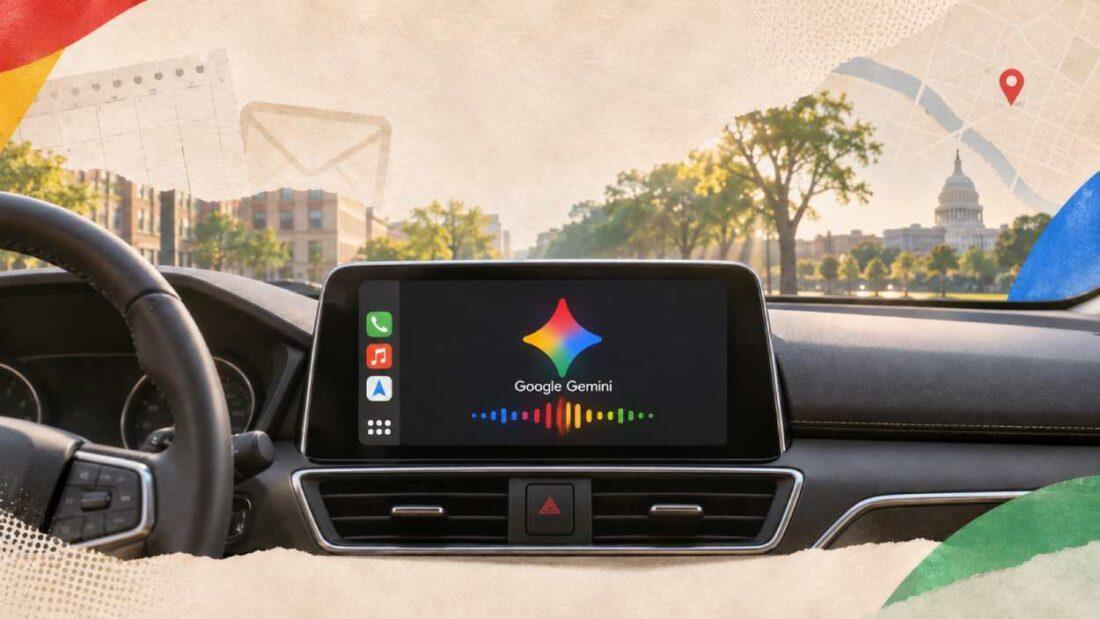
Google Brings Gemini to Apple CarPlay, Turning Every Commute Into an AI Conversation
A car dashboard is becoming more than a place to display maps, music and incoming calls. It is turning into another screen where technology companies want people to spend time with their AI assistants.
Google Connects CarPlay Conversations With Gemini's iPhone Chat History
Google has brought its Gemini app directly to Apple CarPlay. Drivers with supported iPhones can now access Gemini by tapping its icon on the car's display, rather than relying on the chatbot through Google Maps.
The change looks small. Its strategic meaning is much bigger. Google is making Gemini easier to reach during one of the most regular parts of people's lives — the daily commute.
Gemini Gets a Dedicated Place on Apple CarPlay
Google's Gemini app is now available on Apple CarPlay for all supported Gemini Live languages.
Previously, drivers could access Google's AI assistant through the Google Maps app. The new integration gives Gemini its own icon on the CarPlay screen, making it a more direct part of the driving experience.
Users can continue a conversation they started earlier or begin a new one. Their conversations also synchronize with the Gemini iPhone app and remain in their chat history.
This matters because AI assistants become more useful when people can access them without repeatedly starting from scratch.
The Car Is Becoming Another AI Interface
For years, the main digital battleground was the smartphone. Then came smart speakers, watches, connected televisions and other devices.
Now the car is becoming another important destination.
People spend a significant amount of time driving, often with their hands occupied and limited ability to interact with a phone. Voice-based AI offers a natural way to use that time.
Google is positioning Gemini as more than a tool for answering questions. It wants the assistant to help users organize information, prepare for work and make decisions while travelling.
The company has suggested several uses, including preparing for meetings, catching up on emails, listening to a Daily Brief and discovering interesting local places.
These are ordinary tasks, but they reveal Google's larger ambition. The goal is to make Gemini useful throughout the day, not just when someone deliberately opens an AI app.
What Drivers Can Do With Gemini
The integration focuses on voice interaction through Gemini Live.
A driver can tap the Gemini icon and speak naturally. Instead of typing a question or searching through several applications, the user can have a conversation with the assistant.
For example, someone travelling to a business meeting could ask Gemini to help review relevant information or prepare talking points. Another driver might request a summary of recent emails or ask for recommendations about places nearby.
The ability to continue an existing conversation is particularly useful. A person could begin planning something on an iPhone before leaving home and continue the discussion through CarPlay.
That continuity makes the assistant feel less like a standalone application and more like a service that follows the user between devices.
The Requirements Are Simple, but Important
Drivers need the latest version of the Gemini app installed on their iPhone. Microphone permissions must also be enabled, and users must have tried Gemini Live on the iPhone at least once.
The feature is available in languages supported by Gemini Live.
These requirements matter because voice interaction depends on access to the microphone and a working connection between the phone and the car's interface.
Google is not introducing an entirely new AI system for driving. It is extending an existing product into another environment.
That makes the rollout easier to understand. The company can use its existing Gemini infrastructure, app and conversation history rather than building a separate assistant specifically for CarPlay.
Google's Real Advantage Is the Ecosystem
The most important part of this announcement is not the new icon. It is the connection between Gemini and Google's wider software ecosystem.
Google has already expanded its assistant capabilities on Android Auto. It recently enabled Personal Assistance, which can use information from other Google applications to provide more personalized responses.
The company is also bringing Personal Intelligence to Gemini on vehicles with Google built-in.
This creates a broader strategy. Gemini can become more valuable when it understands information spread across a user's digital life.
An assistant that can answer general questions is useful. An assistant that can help organize a meeting using relevant information from connected services could be considerably more useful.
For Google, this creates an opportunity to strengthen the relationship between its AI products and its existing services.
For users, the benefit is convenience. For Google, the benefit is increased engagement and a stronger position in the daily digital experience.
Apple and Google Have Different Roles in the Car
Apple controls the CarPlay platform and the interface through which compatible iPhone applications appear in supported vehicles. Google supplies Gemini as an application within that environment.
This distinction is important.
Google can bring its AI assistant to Apple users without requiring them to own an Android phone or drive a vehicle running Google's built-in automotive software.
That expands Gemini's potential reach.
At the same time, Google remains dependent on the rules and capabilities of Apple's platform. It does not control the entire CarPlay experience.
The competitive challenge is therefore not simply getting Gemini onto more screens. It is making the assistant useful enough that people choose it regularly.
Convenience Comes With Real Risks
Putting AI into a car creates an obvious safety concern.
Driving requires attention. A conversation that becomes too long, complicated or distracting could take a driver's focus away from the road.
Voice interaction reduces the need to look at a phone, but it does not eliminate distraction. Listening to lengthy answers or trying to solve complicated problems while driving can still be dangerous.
Privacy is another concern. Gemini conversations can contain personal information, work details and email-related requests. Users should understand what information the assistant can access and how their conversations are stored.
There is also a reliability question. An AI assistant can misunderstand a request or provide an incorrect answer. That is inconvenient at home or in the office. Behind the wheel, the consequences of distraction or poor information can be more serious.
The weakest point in Google's announcement is that it emphasizes productivity without explaining in detail how the experience will prevent unnecessary distraction. Convenience alone is not a sufficient measure of success for an in-car AI product.
The Business Opportunity Extends Beyond Google
The expansion of AI into vehicles could create opportunities for businesses that provide services people need while travelling.
Restaurants could become easier to discover through conversational recommendations. Hotels, local attractions and service providers could benefit when AI assistants help drivers find relevant destinations.
Small businesses may eventually need to think about how their information appears in AI-generated recommendations, not just traditional search results.
A local restaurant, for example, needs accurate opening hours, location details, menus and customer information wherever digital assistants obtain their answers.
However, appearing in an AI recommendation does not guarantee revenue. Businesses still need competitive pricing, good service and a reason for customers to choose them.
The larger opportunity is a shift in how people discover products and services. Instead of searching through a list of websites, customers may increasingly ask an assistant to narrow down their options.
What Small Businesses Should Do Now
Small and medium-sized businesses do not need to build their own AI assistant because Gemini has arrived on CarPlay.
They should focus on the basics.
Keep business information accurate across digital platforms. Make opening hours, contact details, services and prices easy to understand. Maintain a clear online presence so that search engines and AI-powered services can interpret the business correctly.
Businesses should also experiment with AI tools for practical work, such as preparing meeting notes, summarizing customer feedback and organizing daily operations.
The important lesson is to use AI where it saves time or improves customer service. Buying technology simply because it is new does not create a competitive advantage.
The Bigger Fight Is for Everyday Attention
Google's arrival on Apple CarPlay is another step in the company's effort to make Gemini part of everyday life.
The smartphone remains important, but the future of AI will not be limited to one device. Assistants will increasingly appear wherever people communicate, work, travel and make decisions.
Google has an advantage because it already operates a large ecosystem of software and services. Connecting Gemini to that ecosystem could make its assistant more useful over time.
But distribution is only the beginning. The real test will be whether Gemini provides reliable, safe and genuinely helpful experiences that drivers want to use repeatedly.
The next stage of the AI competition will not be decided only by which company has the most powerful model. It will also be decided by which assistant becomes the most natural part of people's daily routines.
Google Connects CarPlay Conversations With Gemini's iPhone Chat History
Google Gemini CarPlay, Gemini Apple CarPlay, AI driving assistant, Gemini Live, Google AI assistant, Apple CarPlay update, AI in vehicles, voice AI assistant, Google Gemini app, Android Auto AI, connected car technology, AI productivity tools, automotive AI, small business AI
