
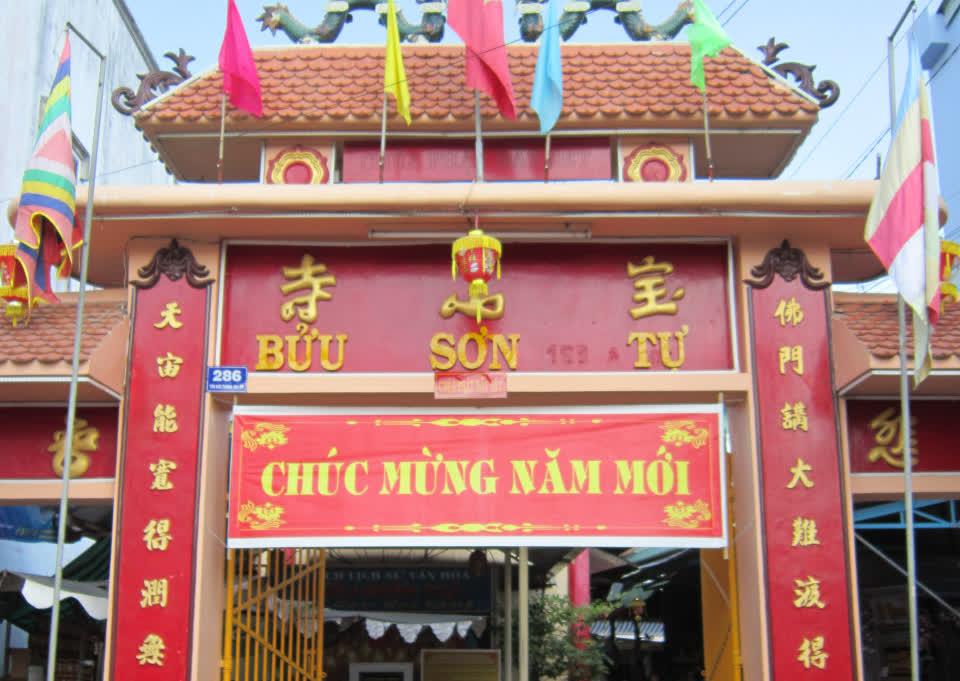
Chua Dat Set In Soc Trang… Vietnam’s Temple Built From Clay, Wax, Silence And Obsession
There are temples in Vietnam that impress you with size. Others with gold, crowds, chanting, incense, or mountain views. Then there is Buu Son Tu — better known as Chua Dat Set, or Clay Temple — a place that feels less like a tourist attraction and more like stepping into someone else’s lifelong fixation.
Located on Ton Duc Thang Street in Soc Trang, in the Mekong Delta of southern Vietnam, this temple does not announce itself dramatically. No giant gates. No cinematic staircase. No orchestral soundtrack from tour buses. It sits quietly among ordinary homes, almost hidden behind daily life. Motorbikes pass. Neighbors hang laundry. A fruit seller shouts prices nearby. Then suddenly, behind a modest entrance, you enter a world where nearly everything was shaped by hand from clay.
Not marble. Not bronze. Clay.
And that detail changes everything.
Most travelers arrive expecting a quick cultural stop. Many stay longer than planned because the temple carries a strangely intimate atmosphere. You are not simply looking at religious objects. You are looking at four decades of one man’s imagination hardened into physical form.
Chua Dat Set, officially called Buu Son Tu, is a family-managed temple in Soc Trang famous for nearly 2,000 handcrafted clay statues, giant wax candles weighing over 1.4 tons combined, and a deeply personal architectural style shaped over 42 years. Unlike major tourist temples in Vietnam, the site feels intimate, residential, and intensely human. Travelers come here not for spectacle alone, but to understand how folk Buddhism, family devotion, craftsmanship, and local spiritual traditions merged into one of the country’s most unusual religious spaces.
A Temple Built By Persistence Rather Than Wealth
The story begins roughly 200 years ago, when a member of the Ngo family established a private place for worship. Unlike most Vietnamese pagodas, Buu Son Tu was never designed as a formal monastic complex. There were no resident monks leading a large religious institution. The temple stayed under family care, passed from generation to generation.
That family-centered structure still shapes the atmosphere today.
A local guide once described the place to me this way:
“Other temples feel institutional. This one feels personal.”
That sentence stays with you while walking through the narrow interior halls.
The transformation of the temple came in 1928, when Ngo Kim Tong — the fourth caretaker of the temple — survived a severe illness that nearly killed him. According to local accounts, he experienced spiritual visions during recovery and decided to dedicate himself completely to restoring and expanding the temple.
But instead of commissioning expensive bronze statues or carved hardwood sculptures, he chose clay.
Not because clay was fashionable. Because it was available.
That practical decision accidentally created one of Vietnam’s most distinctive spiritual landmarks.
Nearly Two Thousand Clay Sculptures
The number sounds exaggerated at first: 1,991 statues and decorative works made from clay.
Yet once inside, the scale becomes believable.
The statues range from small meditative Buddhas to elaborate mythological constructions layered with dragons, lotus petals, celestial guardians, and symbolic animals. Some figures represent Amitabha Buddha, Avalokiteshvara (Quan Am), Shakyamuni Buddha, Confucian imagery, Taoist symbolism, and Vietnamese folk spirituality all at once.
The result is architecturally fascinating because it reflects the Vietnamese concept of “Tam Giao Dong Nguyen” — the coexistence of Buddhism, Confucianism, and Taoism.
Western travelers often expect strict separation between religions. Vietnam rarely works that way.
Inside Chua Dat Set, spiritual traditions overlap naturally.
One of the most intricate works inside the temple is a lotus structure featuring 1,000 lotus petals, each holding a tiny seated Buddha figure. Another striking piece is the Bao Toa Tower, rising around 3.5 meters high with 13 levels and more than 200 miniature doors, supported by detailed dragon sculptures beneath it.
The craftsmanship becomes even more remarkable when you learn the production method.
The clay was dried, crushed, filtered, mixed carefully with natural additives, then sculpted entirely by hand. Afterwards, each piece received layers of paint and protective oils, giving many sculptures the appearance of aged wood rather than earth.
Without being told, many visitors assume the statues are carved timber.
They are not.
And that revelation changes how you look at every surface afterward.
The Candles Everyone Talks About
The statues may attract visitors initially. The candles are what people remember later.
Chua Dat Set contains eight enormous candles made from pure wax. Six large candles weigh roughly 200 kilograms each, while two smaller ones weigh around 100 kilograms each.
The smaller pair has become legendary locally.
According to temple caretakers, these candles have burned continuously for decades since Ngo Kim Tong’s death. Stories surrounding the candles have become part religious devotion, part local folklore, part tourism fascination.
Whether you approach the narrative spiritually or skeptically almost does not matter. Standing beside candles designed to burn for generations creates an unusual sense of time.
Modern tourism often operates on speed. Fifteen-minute visits. Fast photos. Quick uploads.
Chua Dat Set works differently.
The place slows people down.
Things The Media Doesn’t Tell You
Most articles about Chua Dat Set focus only on “the temple made of clay.” That headline is accurate, but incomplete.
What many travel videos skip is how physically compact the temple actually is. This is not a sprawling temple complex like those in Kyoto, Bangkok, or Angkor. The experience is dense rather than massive. The details matter more than scale.
Another reality: lighting inside can be dim. Photography enthusiasts expecting perfectly illuminated museum conditions may struggle. Smartphone cameras sometimes over-process the warm interior colors, making sculptures appear artificial online compared to real life.
Several recent Vietnamese vloggers also point out something useful for planners: the surrounding neighborhood is residential and quiet, so arriving respectfully matters. Loud tour behavior feels especially intrusive here.
Negative reviews on Google Maps and travel forums usually mention three things:
- Limited English explanations inside
- Small interior walkways during busy periods
- Heat and humidity in the afternoon
Those criticisms are fair. But they also reveal what the temple is not trying to become. Chua Dat Set does not feel optimized for mass tourism. It still feels rooted in local rhythm.
If you want deeper context before visiting, practical research methods include:
- Reading recent low-star reviews for crowd and access patterns
- Watching current TikTok walkthroughs for realistic interior conditions
- Checking Vietnamese Facebook travel groups for local transport updates
- Watching YouTube vlogs filmed during festivals or rainy season
That combination often gives more accurate expectations than polished tourism brochures.
A Planner’s Perspective… How To Visit Properly
If you are building a Mekong Delta itinerary, Chua Dat Set works best as part of a broader Soc Trang cultural day rather than a standalone destination.
The temple pairs well with:
- Khmer pagodas around Soc Trang
- Local noodle shops serving hu tieu or bun nuoc leo
- Traditional Chinese-Vietnamese neighborhoods
- Riverfront markets in the early morning
The most effective schedule is usually:
- Early breakfast in Soc Trang
- Temple visit before midday heat
- Slow neighborhood exploration afterward
- Optional continuation toward Bac Lieu or Can Tho
Avoid treating the site like a “checklist attraction.” The temple rewards slower observation.
One travel researcher specializing in Southeast Asian religious architecture explained it this way:
“The emotional impact comes from accumulation. One clay statue is interesting. Two thousand created by one family across decades becomes psychologically overwhelming.”
That insight captures the place perfectly.
Why International Travelers Find It Memorable
International visitors often arrive expecting exotic spectacle and leave talking instead about devotion, patience, and handmade craftsmanship.
Because Chua Dat Set is not grand in the conventional sense.
It does not dominate a skyline. It does not overwhelm with gold towers or giant courtyards. Its power comes from density, repetition, and human labor. Every sculpture quietly reminds you that somebody shaped this with fingers, tools, and time.
That intimacy feels increasingly rare in modern travel.
Especially in Southeast Asia, where many famous attractions now operate inside heavy tourism infrastructure, Chua Dat Set still retains a slightly improvised atmosphere. You feel close to the objects. Close to the walls. Close to the story.
And perhaps that is why travelers remember it.
Not because it is the biggest temple in Vietnam.
Because it may be one of the most personal.
Community Notes From Travelers
“I thought I’d stay twenty minutes. I stayed almost two hours studying the details.”
“The outside looks ordinary. The inside feels like entering someone’s imagination.”
“Photos don’t explain the atmosphere properly. You need to see the texture of the clay in person.”
“It’s one of those places where silence becomes part of the architecture.”
A Different Side Of The Mekong - Discovering The Clay Temple Of Soc Trang
Chua Dat Set, Clay Temple Vietnam, Soc Trang temple, Buu Son Tu, Vietnam spiritual sites, Mekong Delta travel, clay statues Vietnam, unusual temples Asia, wax candle temple, Vietnamese Buddhism, Soc Trang attractions, Vietnam cultural travel, hidden Vietnam temples, Vietnam heritage sites, Buddhist architecture Vietnam
