
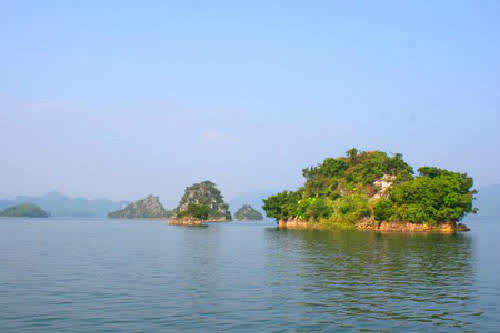
Thung Nai - Vietnam’s “Inland Ha Long Bay” That Still Feels Unfinished By Tourism
Northern Vietnam has a habit of hiding its most memorable landscapes behind ordinary roads. You leave Hanoi expecting traffic, industrial suburbs, concrete towns, and roadside tea stalls. Then, a few hours later, the mountains begin folding into each other, the air cools slightly, and suddenly the world slows down around the Da River reservoir.
This is Thung Nai.
Located in Cao Phong District, Hoa Binh Province, around 110 kilometers from Hanoi, Thung Nai has quietly become a weekend escape for travelers who want something gentler than Sa Pa and less commercial than Ha Long Bay. Vietnamese travelers often call it “Ha Long on land,” though that nickname only partially explains the experience. Yes, there are limestone formations rising from calm water. Yes, there are scattered islands and drifting boats. But Thung Nai feels less dramatic than Ha Long and more intimate — closer to a watercolor painting than a blockbuster film set.
The appeal is not speed. It is atmosphere.
You come here to sit on a slow-moving boat, watch fog drift across the reservoir at dawn, eat grilled river fish with Muong families, and listen to silence interrupted only by wind and boat engines.
For many travelers from Europe or North America, that stillness becomes the real attraction.
Thung Nai, located inside the Da River reservoir in Hoa Binh Province, combines mountain scenery, lake islands, caves, floating markets, and Muong cultural traditions into one of northern Vietnam’s most atmospheric short escapes from Hanoi. Accessible mainly by boat, the area offers travelers a slower and more reflective experience compared to Vietnam’s heavily commercialized destinations. Key attractions include Thac Bo Cave, Thac Bo Temple, floating market culture, island homestays, and panoramic lake viewpoints centered around the famous windmill island.
A Landscape Accidentally Created By Water
What makes Thung Nai unusual is that its famous scenery was not entirely natural in the form visitors see today.
The region sits within the reservoir area created by the Hoa Binh Hydropower Plant on the Da River. As water levels rose over time, valleys submerged, hills transformed into islands, and mountain peaks emerged from the lake like scattered stone towers.
That mixture of natural geology and human-engineered flooding created the visual identity travelers now associate with Thung Nai.
An environmental travel researcher once described the place this way:
“Thung Nai is not untouched nature. It is a landscape redesigned by water, memory, and adaptation.”
That perspective matters because it changes how you interpret the scenery. The lake is beautiful, certainly, but it is also part of a larger story about energy, relocation, river systems, and changing livelihoods in northern Vietnam.
Still, when viewed from a boat under morning mist, theory disappears quickly.
The place simply looks extraordinary.
Why The Journey Matters As Much As The Destination
Unlike destinations where visitors rush from landmark to landmark, Thung Nai works best when approached slowly.
You leave your vehicle near the lakeside docks and continue by motorboat. That transition changes your mindset almost immediately. The noise of highways disappears. Mobile signal weakens in some sections. Water replaces roads.
Then the scenery opens.
Large mountain ridges surround the reservoir. Small rocky islands rise unexpectedly from the water. Fishermen drift quietly between coves. Occasionally you pass floating fish farms or isolated guesthouses balanced above the lake.
The comparison to Ha Long Bay becomes understandable here, though the emotional tone differs.
Ha Long Bay feels cinematic.
Thung Nai feels reflective.
The boat itself becomes part of the experience. Travelers often spend more time looking outward than taking photos, which is increasingly rare in Vietnam’s tourism economy.
The Story Behind The Name “Thung Nai”
The name “Thung Nai” loosely translates to “Valley of Deer.”
According to local stories, the area once supported populations of wild deer roaming through forested slopes near the Da River. Residents described scenes of deer grazing at sunset while their reflections appeared in the river below.
The deer are gone now.
But the mythology stayed.
And oddly enough, the landscape still carries that same softness. Even without wildlife, there is something pastoral about the place — especially during early morning fog when mountain outlines blur into the water.
Thac Bo Cave… The Underground Contrast To The Open Lake
Most visitors eventually stop at Dong Thac Bo, or Thac Bo Cave, one of the region’s best-known natural sites.
From outside, the cave entrance appears modest and partly hidden inside the mountain. Inside, however, the atmosphere changes dramatically. The heat softens. Moisture thickens the air. Limestone formations emerge from darkness in strange shapes resembling curtains, pillars, frozen waterfalls, or abstract sculptures.
During higher water seasons, shallow clear water sometimes reaches sections of the cave floor, reflecting the stalactites above.
A Vietnamese guide joked during one tour:
“Outside you photograph the mountains. Inside you photograph time.”
That description feels accurate.
Unlike highly commercialized caves elsewhere in Vietnam, Thac Bo still retains a slightly raw quality. Lighting remains relatively restrained. Pathways are functional rather than theatrical.
Which means the cave still feels geological rather than engineered for Instagram.
Thac Bo Temple… Spiritual Geography Above The Water
Near the cave sits Den Ba Chua Thac Bo — Thac Bo Temple — perched against steep hillsides overlooking the reservoir.
For many Vietnamese travelers, this spiritual stop matters as much as the scenery itself.
Pilgrims arrive by boat carrying incense, fruit, flowers, and prayers for luck, business success, or family wellbeing. The climb to the temple changes depending on water levels. During dry periods, visitors must climb steep stone steps from the shore. When reservoir levels rise, boats can dock almost directly beside the temple entrance.
That constantly changing access route gives the temple an unusual relationship with the lake.
From above, the views become exceptional. Clouds drift across distant mountains while small ethnic minority villages appear between forested slopes.
This is one of the few places in northern Vietnam where spiritual tourism and landscape tourism merge naturally without feeling forced.
Things The Media Doesn’t Tell You
Travel articles often describe Thung Nai as peaceful — which is true — but they rarely explain how weather-dependent the experience actually is.
Fog can either transform the landscape into something cinematic or completely erase visibility for hours. During rainy periods, boat schedules occasionally shift, and lake surfaces become rougher than expected.
Another reality: infrastructure remains limited compared to major tourist hubs.
Some travelers love this. Others find it inconvenient.
Recent negative reviews and travel forum discussions commonly mention:
- Limited nightlife and entertainment
- Few English-speaking guides outside organized tours
- Inconsistent mobile reception on the lake
- Basic restroom conditions at some docking points
- Seasonal water-level changes affecting photography
These details matter because expectations shape experiences.
If you want realistic pre-trip information without physically scouting the area first, useful research methods include:
- Watching recent YouTube vlogs filmed during different seasons
- Reading Google Maps reviews sorted by lowest rating first
- Checking Vietnamese Facebook travel groups for weather updates
- Searching TikTok for current boat dock conditions and crowds
Interestingly, these sources often reveal more practical information than official tourism websites.
For planners, weekday travel works best. Sundays attract local visitors heading to Thac Bo Floating Market, which adds atmosphere but also increases boat traffic and noise.
The Floating Market Most Foreign Travelers Miss
One of the more overlooked cultural elements of Thung Nai is Cho Noi Thac Bo — the floating market that appears on Sundays.
This is not a giant floating market like those in the Mekong Delta. It feels smaller, quieter, and more local. Muong residents arrive by boat carrying produce, household goods, snacks, and daily necessities.
The market matters less for shopping and more for observation.
You begin noticing how water shapes local routines. Boats replace motorbikes. Conversations happen between floating platforms. Deliveries arrive by river.
For travelers interested in anthropology or regional culture, this part of Thung Nai can be more rewarding than the scenery itself.
The Windmill Island Everyone Photographs
At some point during most boat routes, travelers notice a large windmill standing on a small island above the reservoir.
The structure feels slightly surreal against the mountainous backdrop. Some compare it to Dutch countryside imagery. Others mention old European novels or fantasy illustrations.
In reality, the windmill functions partly as a visual landmark for a lakeside accommodation area. Yet it has evolved into an unofficial symbol of Thung Nai itself.
And yes, the viewpoint is excellent.
Early morning offers soft mist and pale silver water. Late afternoon creates golden reflections across the lake surface. Photographers often linger here longer than planned.
Food In Thung Nai… Simpler Than You Expect
The meals in Thung Nai are not designed for fine dining tourism.
That is exactly why many visitors enjoy them.
Muong-style meals often include:
- Stream fish grilled over charcoal
- Hill chicken
- Forest vegetables
- Sticky rice
- Light herbal dipping sauces
The flavors tend to be direct rather than heavily spiced. Ingredients matter more than presentation.
One travel writer described the meals perfectly:
“The food tastes like geography.”
In Thung Nai, that geography is water, forest, mountain air, and isolation.
Why Thung Nai Works Best For Slow Travelers
Some destinations reward ambition. Others reward patience.
Thung Nai belongs firmly in the second category.
You do not come here to maximize attractions per hour. You come to drift between mountains, listen to local stories, drink tea beside the lake, and temporarily disconnect from the rhythm of larger Vietnamese cities.
And in a country increasingly shaped by rapid tourism growth, that slower pace may be exactly what makes Thung Nai memorable.
Community Quotes
“It felt like Ha Long Bay without the pressure to perform as a tourist.”
“The fog changed everything. One minute the islands vanished completely, the next they reappeared like paintings.”
“I expected scenery. I didn’t expect the silence.”
“The floating market was small, but it felt authentic rather than staged.”
Thung Nai Boat Trips - The Most Relaxing Journey Near Hanoi.
Thung Nai travel, Hoa Binh tourism, inland Ha Long Bay, Thung Nai boat trip, Da River lake, Thac Bo Temple, Thac Bo Cave, northern Vietnam travel, Muong culture, Vietnam lake islands, weekend from Hanoi, Vietnam slow travel, Hoa Binh attractions, floating market Vietnam, Vietnam nature escape
