
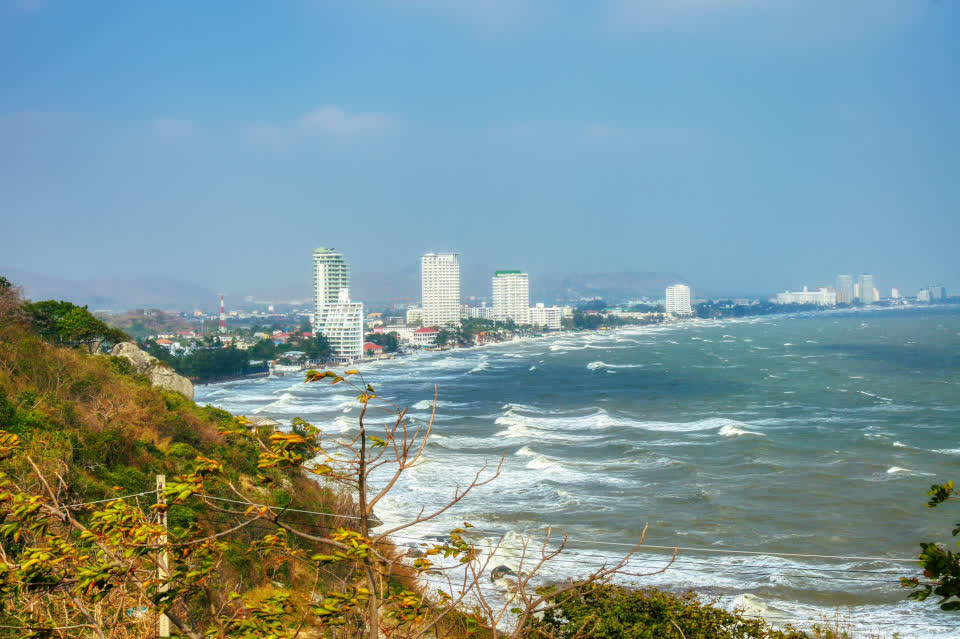
Hua Hin Thailand . A Slower Coastal Town Beyond Bangkok’s Intensity
Full Summary Table
| Category | Details |
|---|---|
| Destination | Hua Hin |
| Main identity | Royal seaside retreat |
| Famous landmark | Klai Kangwon Palace |
| Historic attraction | Hua Hin Railway Station |
| Cultural area | Plearnwan |
| Evening activity | Hua Hin Night Market |
| Architectural tone | Thai-Sala + Spanish influences |
| Travel atmosphere | Slow-paced, nostalgic, family-friendly |
| Best travel style | Walking, observation, evening exploration |
| Ideal traveler | Families, slow travelers, cultural observers |
Hua Hin Thailand . A Slower Coastal Town Beyond Bangkok’s Intensity
Thailand is often sold through acceleration.
Bangkok traffic. Phuket nightlife. Pattaya neon. Island-hopping itineraries compressed into social-media-sized attention spans.
But Hua Hin moves differently.
Not slower because it lacks energy.
Slower because it never fully surrendered to urgency in the first place.
This coastal town has long functioned as a retreat space—not only for travelers, but historically for Thai royalty itself. And that legacy shaped the city’s emotional architecture.
One travel observer once wrote:
“Some destinations ask you to consume experiences. Others quietly teach you how to notice them.”
Hua Hin belongs to the second category.
You don’t arrive here to be overwhelmed.
You arrive here to recalibrate.
Klai Kangwon Palace . Royal Architecture Without Excess
More than half a century ago, Klai Kangwon Palace became associated with the honeymoon retreat of King Bhumibol Adulyadej (Rama IX) and Queen Sirikit.
The palace remains one of Hua Hin’s defining structures—not because of scale, but because of restraint.
Positioned quietly on the northern outskirts of the city, the palace avoids the dramatic grandeur often associated with royal compounds elsewhere in Thailand.
Instead, the architectural language feels softened:
- Low-rise Spanish-inspired structures
- Thai Sala design elements
- Long open corridors
- Parallel columns guiding ocean airflow
- Garden-centered spatial planning
The emotional difference compared with Bangkok’s royal architecture is immediate.
Bangkok palaces often project ceremony and spectacle.
Klai Kangwon projects breathing space.
Neutral tones dominate the property:
- Soft whites
- Muted creams
- Natural greens
Nothing aggressively demands attention.
At the center of the grounds sits a fountain surrounded by white-painted wooden benches. Nearby, a royal museum displays photographs and memorabilia connected to the Thai royal family.
The experience feels less like entering a monument and more like entering a carefully preserved rhythm of living.
Hua Hin Railway Station . Thailand Through a Railway Lens
If one structure symbolizes Hua Hin emotionally, it is probably the railway station.
Built during the reign of King Rama VII, the station coincided with Hua Hin’s transformation into a royal summer retreat connected directly to Bangkok.
Architecturally, the station reflects traditional Thai Sala design:
- Wooden construction
- Ornamental roofing
- Open-air waiting spaces
- Deep red and gold color accents
Today, it functions not only as infrastructure but as memory.
Late afternoon is the ideal time to visit.
As the city lights begin activating one by one, the station changes character entirely. Bells echo softly. Train movement interrupts the stillness briefly, then disappears again almost immediately.
One writer once described old railway stations this way:
“Train stations are among the few places where movement and nostalgia coexist without conflict.”
That tension defines Hua Hin station perfectly.
The trains arrive hurriedly.
The station itself remains patient.
Night Market Dynamics . The Social Core of Hua Hin
Leave the railway station, turn left along the road outside, and you eventually reach Hua Hin’s night market system.
The atmosphere changes quickly:
- Smoke from Thai street food
- Bright signage
- Dense pedestrian movement
- Vendors calling across narrow pathways
But unlike larger Thai markets, Hua Hin’s version feels more compressed and conversational.
The scale remains manageable.
Visitors encounter:
- Local snacks
- Seafood dishes
- Souvenirs
- Traditional crafts
The market works particularly well for families and slower travelers because navigation stress remains relatively low compared with Bangkok night markets.
And importantly, people here still seem willing to linger.
That matters more than most travel guides admit.
Plearnwan . Reconstructing Memory Through Design
Plearnwan is not an ancient district. It was rebuilt in 2009.
But dismissing it as “artificial nostalgia” would miss the point entirely.
The project was designed to preserve and reinterpret Hua Hin’s older fishing-village identity:
- Elevated wooden homes
- Traditional riverside living patterns
- Open-air storefronts
- Vintage-style retail spaces
Murals across the area reconstruct scenes from older Hua Hin daily life.
The architecture deliberately slows visitors down:
- Narrow walkways
- Elevated structures
- Layered storefronts
- Visual repetition of wood textures
This creates a form of spatial storytelling.
One experienced traveler once observed:
“Places like Plearnwan are less about historical accuracy and more about emotional continuity.”
That distinction matters.
Travelers are not only searching for authenticity anymore.
They are searching for coherence.
Hua Hin’s Real Strength . Emotional Scale
Many destinations compete through magnitude:
- Taller buildings
- Larger beaches
- More attractions
- Faster entertainment cycles
Hua Hin does not.
Its strength lies in emotional proportion.
Nothing feels excessively amplified:
- Streets remain human-scaled
- Architecture stays breathable
- Nightlife rarely overwhelms
- Coastal atmosphere softens urban tension
This makes the city particularly attractive for:
- Families
- Older travelers
- Burned-out urban professionals
- Long-stay visitors
Especially those arriving from fast-moving metropolitan environments.
Things the Media Doesn’t Tell You
This is where planning becomes more useful than romantic storytelling.
1. Hua Hin Is Not Thailand’s “Spectacle Destination”
If you expect:
- giant nightlife districts,
- nonstop entertainment,
- dramatic tourism infrastructure,
you may initially misread the city.
Hua Hin rewards observation more than stimulation.
2. The Weather Shapes the Experience Heavily
Heat and humidity influence:
- walking pace,
- market comfort,
- afternoon energy levels.
Evening exploration works significantly better than midday touring.
3. Nostalgia Here Is Partly Curated
Places like Plearnwan intentionally reconstruct older aesthetics.
That does not automatically make the experience fake.
But travelers should understand the distinction between preservation and re-creation.
4. Public Transport Is Less Efficient Than Bangkok
Movement inside Hua Hin often depends on:
- tuk-tuks,
- walking,
- local transport negotiation.
Planning flexible travel time matters.
5. The Calmness Can Feel “Too Quiet” for Some Travelers
Especially younger visitors expecting:
- beach parties,
- loud nightlife,
- high-density tourism zones.
Hua Hin’s atmosphere is intentionally softer.
6. Royal Heritage Influences the City’s Identity
This affects:
- urban aesthetics,
- zoning,
- atmosphere,
- local respect toward certain areas.
The town feels more restrained partly because of this historical relationship.
7. The Best Experiences Happen Between Attractions
Not inside landmarks.
Often the strongest moments come from:
- waiting beside the railway tracks,
- watching street vendors prepare food,
- hearing distant train bells after sunset,
- sitting quietly in open-air corridors.
Those moments cannot be scheduled precisely.
How to Gather Real-World Data Before Visiting
If you want updated insight before traveling:
- Read negative Google reviews about transport and crowd conditions
- Watch recent YouTube walking tours filmed after sunset
- Browse Thailand travel Facebook groups for seasonal updates
- Search TikTok for real-time night market atmosphere
- Compare weekday vs weekend footage to understand crowd density
Without recent validation, expectations become overly romanticized.
Community Perspective
Long-term Southeast Asia travelers often describe Hua Hin with unusual consistency:
“It feels like Thailand before tourism became performance.”
Not untouched.
Not isolated.
Just less aggressive in how it presents itself.
That subtle difference is exactly why many people return.
Hua Hin Cultural Route . Vintage Streets, Thai Railways, and Coastal Calm.
Hua Hin Thailand, Hua Hin travel guide, Klai Kangwon Palace, Hua Hin railway station, Hua Hin night market, Plearnwan Hua Hin, Thailand coastal town, Hua Hin itinerary, Hua Hin culture, slow travel Thailand, Hua Hin architecture, Thailand royal retreat, Hua Hin evening walk, Hua Hin family trip, Hua Hin local experience
